
2X Better Learning Outcomes vs Traditional Schooling: Why Personalized Education Is Reshaping Learning
For more than a century, traditional schooling has followed a one-size-fits-all model. While this system has educated generations of students, today's rapidly c
Aalgorix World Academy
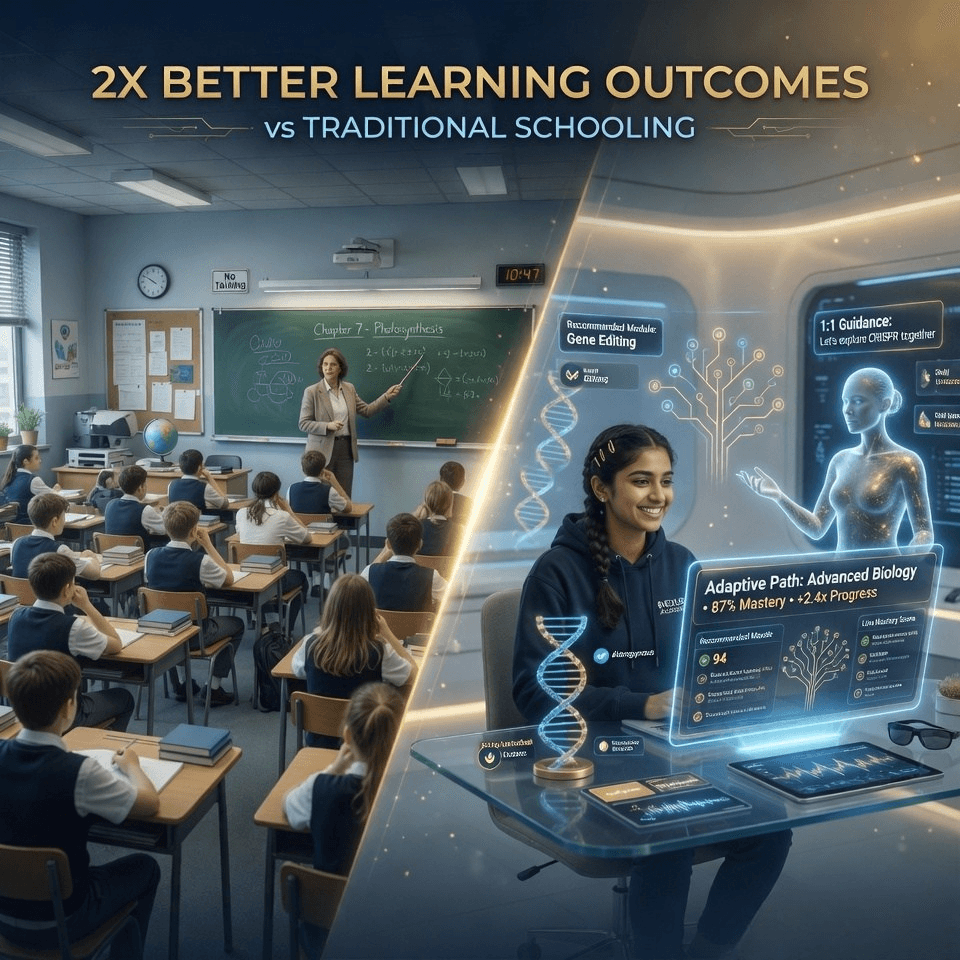
For more than a century, traditional schooling has followed a one-size-fits-all model. While this system has educated generations of students, today's rapidly changing world demands a more personalized and adaptive approach to learning.
Recent advancements in educational technology, artificial intelligence, and homeschooling methodologies are challenging the conventional classroom model. Studies increasingly suggest that students who receive personalized instruction often achieve significantly better academic outcomes, with some research indicating up to 2X improvement in learning efficiency and retention compared to traditional approaches.
So, what makes personalized learning so effective?
The Challenge with Traditional Schooling
Traditional classrooms are designed to teach large groups of students simultaneously. While efficient from an administrative perspective, this model presents several challenges:
Fixed learning pace for all students
Limited individual attention
Standardized teaching methods
Difficulty addressing diverse learning styles
Reduced flexibility in curriculum and scheduling
In a classroom of 30–40 students, teachers often face the impossible task of meeting every student's unique needs. As a result, some learners fall behind while others remain underchallenged.
What Drives Better Learning Outcomes?
Research consistently shows that students learn best when education is tailored to their abilities, interests, and pace.
Personalized learning environments provide:
Individual Learning Paths
Students progress based on mastery rather than age or grade level. This ensures foundational concepts are fully understood before advancing.
Immediate Feedback
Modern AI-powered learning systems can identify knowledge gaps instantly, helping students correct mistakes before misconceptions become permanent.
Adaptive Learning Pace
Fast learners can move ahead without waiting for the class, while students needing extra support receive additional practice and guidance.
Higher Engagement
When lessons align with a student's interests and learning style, motivation naturally increases.
The Role of AI in Modern Learning
Artificial Intelligence is transforming education from standardized instruction to personalized guidance.
AI-powered tutors can:
Analyze student performance in real time
Recommend customized learning materials
Provide instant explanations
Track progress continuously
Create individualized learning experiences
Unlike traditional classrooms, AI-driven systems are available anytime, enabling students to learn beyond school hours.
Homeschooling and Personalized Education
Homeschooling has emerged as one of the strongest examples of personalized learning.
Parents and educators can:
Adapt curriculum to individual strengths
Focus on mastery instead of memorization
Encourage critical thinking and creativity
Integrate real-world experiences into learning
Create flexible schedules that reduce stress
When combined with AI-powered educational tools, homeschooling becomes an even more powerful model for student success.
Beyond Academic Performance
Better learning outcomes are not limited to higher test scores.
Students in personalized learning environments often develop:
Stronger problem-solving skills
Greater self-confidence
Independent learning habits
Improved critical thinking
Enhanced creativity and innovation
These skills are increasingly important in a world where adaptability and lifelong learning are essential.
The Future of Education
The future is unlikely to be a choice between traditional schooling and homeschooling. Instead, education is moving toward a hybrid model that combines:
Human mentorship
AI-powered personalization
Flexible learning environments
Competency-based progression
Technology-enhanced instruction
The goal is simple: ensure every learner receives the support they need to reach their full potential.
Conclusion
The conversation is no longer about whether technology should be part of education. The real question is how we can use it to create better learning experiences for every student.
As personalized learning, AI tutors, and homeschooling continue to evolve, the evidence points toward a future where students can achieve significantly better outcomes than those possible through traditional one-size-fits-all models.
Education is shifting from teaching everyone the same way to helping every learner succeed in their own way—and that may be the most important innovation of all.