
AI-Powered Homeschooling: What Happens When Every Child Has a Personal Tutor?
AI-Powered Homeschooling: What Happens When Every Child Has a Personal Tutor? Imagine a homeschooling environment where your child doesn't have to wait until th
Aalgorix World Academy
AI-Powered Homeschooling: What Happens When Every Child Has a Personal Tutor?
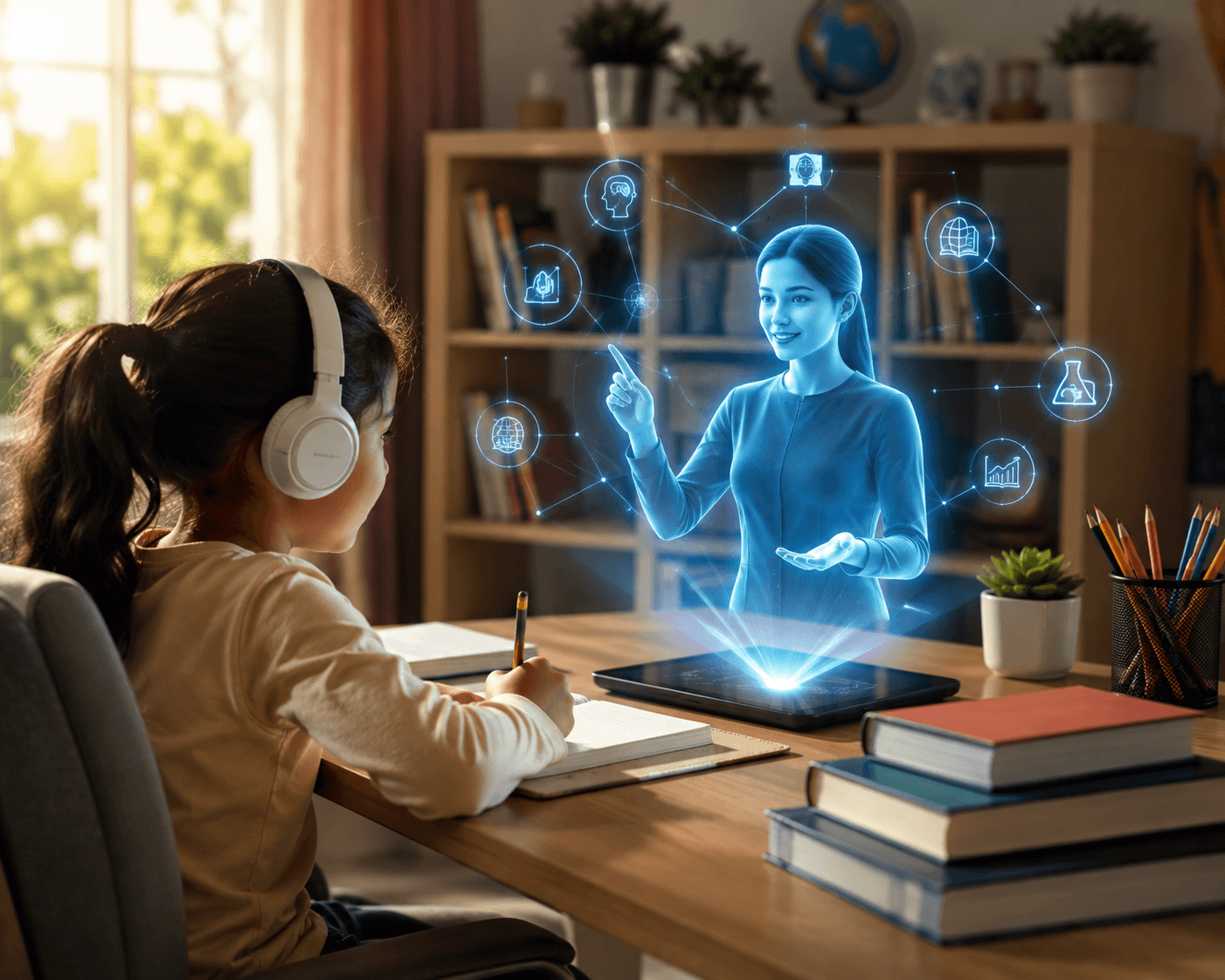
Imagine a homeschooling environment where your child doesn't have to wait until the next lesson to ask a question.
A learning system is available whenever they need help. It explains difficult concepts in different ways, adjusts the level of difficulty, identifies areas where they are struggling, and creates additional practice based on their needs.
This is the promise of AI-powered homeschooling.
Artificial intelligence is changing the way personalized education can be delivered. Instead of every student following exactly the same learning path, AI can help create a more individualized experience based on a student's progress, pace, interests, and learning needs.
But what actually happens when every child has access to a personal AI tutor?
What Is AI-Powered Homeschooling?
AI-powered homeschooling combines traditional homeschooling with artificial intelligence and digital learning technologies.
Instead of relying entirely on textbooks, worksheets, and parent-led instruction, families can use AI-powered tools to support:
Personalized lessons
Practice and revision
Question answering
Learning assessments
Progress tracking
Curriculum planning
Feedback
Learning-gap identification
Study recommendations
The goal isn't to remove parents from education.
Instead, AI can act as an additional learning partner, while parents remain responsible for guidance, values, motivation, and important educational decisions.
From One Curriculum to Individual Learning Paths
Traditional education often organizes students by age and grade.
A 10-year-old student may be expected to study the same mathematics topics as other 10-year-olds, even though students can have very different levels of understanding.
AI-powered homeschooling can approach this differently.
Consider three students studying fractions:
Student A understands fractions quickly and moves to more challenging problems.
Student B understands basic fractions but needs additional practice.
Student C struggles because they haven't fully understood multiplication and division.
Instead of giving all three students the same worksheet, an adaptive system can potentially recommend different learning activities.
This creates a learning model based more on mastery than simply age or grade level.
How Does a Personal AI Tutor Work?
A sophisticated AI tutor can combine several types of information to personalize learning.
1. Student Performance
The system can analyze answers, assessments, and practice activities.
2. Learning History
It can consider which concepts the student has already studied and how they performed.
3. Learning Pace
The system can observe how quickly a student progresses through different concepts.
4. Learning Gaps
Repeated mistakes can indicate concepts that need additional attention.
5. Student Interests
Learning activities can potentially be connected to subjects or themes the child enjoys.
For example, a child interested in football might encounter mathematics problems involving scores, statistics, or player performance.
The result is a learning experience that can become increasingly personalized over time.
AI Tutors Can Explain the Same Concept Differently
One of the biggest advantages of AI-based learning is the ability to provide multiple explanations.
Suppose a child doesn't understand photosynthesis.
A traditional textbook provides one explanation.
A parent might explain it differently.
An AI tutor can potentially provide several approaches:
Simple explanation: Explain photosynthesis using age-appropriate language.
Analogy: Compare a plant to a small food-making factory.
Step-by-step explanation: Break the process into individual stages.
Practice: Ask questions to check understanding.
Application: Connect the concept to real plants and sunlight.
If the first explanation doesn't work, the system can try another approach.
This can make learning more responsive.
What Happens When a Child Makes a Mistake?
A good AI tutor should not simply say:
"Wrong answer."
Instead, it can help investigate the mistake.
For example, a student repeatedly answers fraction questions incorrectly.
The system might determine that the student understands addition but struggles with finding common denominators.
It can then:
Identify the potential problem.
Review the prerequisite concept.
Explain it again.
Provide simpler examples.
Give targeted practice.
Reassess understanding.
Return the student to the original lesson.
This process is sometimes described as adaptive learning.
The learning pathway changes according to the student's needs.
AI Can Help Parents Become Better Learning Coaches
AI-powered homeschooling doesn't mean parents become unnecessary.
In many cases, the parent's role can become more strategic.
Instead of spending all their time creating worksheets or repeatedly explaining the same concept, parents can focus on:
Understanding their child's progress
Encouraging curiosity
Discussing ideas
Supporting projects
Developing life skills
Providing emotional support
Making educational decisions
A parent dashboard could potentially show information such as:
Mathematics: Strong progress Reading: On track Science: Needs reinforcement Critical thinking: Developing
This gives parents a clearer picture of where their attention may be most useful.
What About Children Who Learn Faster?
Personalization isn't only about helping students who struggle.
Advanced learners can also benefit.
If a student demonstrates strong understanding of a topic, an adaptive learning system can potentially introduce:
More challenging problems
Advanced concepts
Independent projects
Research activities
Real-world applications
This can reduce the problem of students feeling held back because they have already mastered the current material.
AI-Powered Homeschooling Can Support Self-Directed Learning
One of the long-term goals of education is to help children become independent learners.
AI can support this by allowing students to:
Ask questions independently
Explore new topics
Practice concepts
Receive immediate feedback
Track their progress
Set learning goals
Explore subjects beyond the curriculum
Over time, children can learn not only what to learn, but also how to learn.
This is especially relevant in homeschooling, where learning doesn't always have to be confined to a fixed classroom schedule.
What About Social and Emotional Development?
This is where human involvement remains extremely important.
AI can help with academic learning, but children also need:
Human relationships
Collaboration
Communication
Empathy
Creativity
Physical activity
Real-world experiences
Emotional support
An AI tutor should therefore be viewed as one component of a broader educational environment.
A strong model could look like:
AI Tutor + Parent + Community + Real-World Experiences
rather than:
AI Tutor instead of everyone else.
The Biggest Challenge: Trust
The idea of giving every child an AI tutor is exciting, but it also creates important questions.
Is the AI always correct?
No. AI systems can sometimes generate inaccurate or misleading information.
Should children accept every AI answer?
No. Students should learn to question, verify, and critically evaluate information.
Should AI make educational decisions alone?
For important decisions, human oversight remains valuable.
What about children's data?
Privacy and responsible data handling are critical when technology is used in children's education.
The future of AI tutoring therefore isn't simply about building more powerful AI.
It's about building safe, reliable, transparent, and educationally responsible AI.
What Could Homeschooling Look Like in the Future?
Imagine a child's learning journey five years from now.
In the morning, the student completes a personalized mathematics lesson.
The AI tutor notices that the student has mastered the current concept and introduces a more challenging problem.
Later, the child studies science through an interactive project.
The system recognizes that the student is particularly interested in space and recommends additional astronomy activities.
At the end of the week, the parent receives a progress summary showing:
Concepts mastered
Areas requiring reinforcement
Learning progress
Recommended activities
Upcoming learning goals
The parent doesn't have to micromanage every lesson.
Instead, they can focus on understanding the bigger picture of their child's development.
That is the potential of AI-powered homeschooling.
AI Tutor vs Traditional Tutoring
AI tutors and human tutors don't necessarily need to compete.
They can complement one another.
AI Tutor | Human Tutor |
Available on demand | Scheduled availability |
Can provide repeated practice | Provides human interaction |
Can adapt explanations | Understands emotional context |
Can analyze learning patterns | Uses human judgment |
Can personalize digital activities | Provides mentorship |
Scales across many students | Builds personal relationships |
The strongest educational model may combine the strengths of both.
The Future Isn't Just an AI Tutor
The biggest change may not be that every child gets a chatbot.
The bigger transformation could be the creation of an AI-powered learning ecosystem.
Such a system could connect:
Curriculum → AI Tutor → Assessment → Learning Analytics → Parent Dashboard → Personalized Learning Path
Instead of simply answering questions, AI could help coordinate the student's entire learning journey.
This moves AI tutoring from question answering toward continuous learning support.
Final Thoughts
AI-powered homeschooling has the potential to make personalized education more accessible.
A personal AI tutor could help students learn at their own pace, receive explanations suited to their understanding, practice areas where they struggle, and explore subjects that interest them.
But technology alone doesn't create great education.
The most promising future is not AI replacing parents or teachers.
It is AI supporting parents, educators, and students to create learning experiences that are more personalized, adaptive, and engaging.
Every child may eventually have access to a personal AI learning companion.
The real question is not whether AI can teach.
The real question is how we can use AI to help every child learn better—while keeping human guidance at the center of education.