
How AI Can Help Teachers Spend More Time Teaching
How AI Can Help Teachers Spend More Time Teaching Teachers do much more than stand in front of a classroom and explain lessons. They plan classes, prepare assig
Aalgorix World Academy
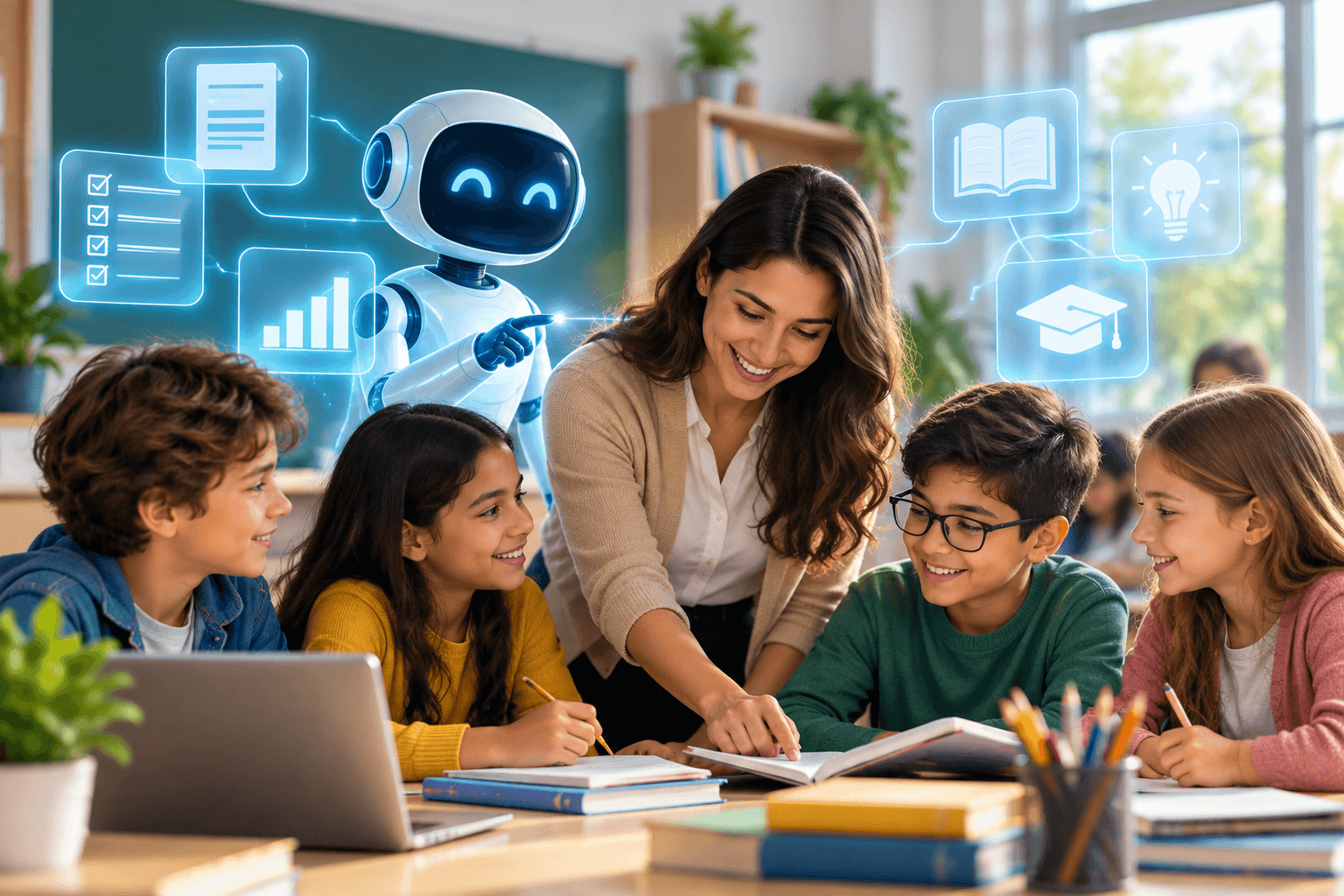
How AI Can Help Teachers Spend More Time Teaching
Teachers do much more than stand in front of a classroom and explain lessons.
They plan classes, prepare assignments, evaluate student work, answer questions, track progress, communicate with parents, manage administrative tasks, and provide individual support to students.
As these responsibilities continue to grow, one important question is emerging:
Can AI help teachers spend less time on repetitive tasks and more time actually teaching?
The answer is increasingly yes.
Artificial intelligence can support teachers by automating certain routine activities, providing learning insights, assisting with content creation, and helping personalize support for students.
The goal isn't to replace teachers.
The goal is to give teachers more time for the parts of education that require human judgment, empathy, creativity, and connection.
The Teacher's Time Problem
A teacher's working day extends far beyond classroom hours.
A typical teaching workflow may involve:
Preparing lesson plans
Creating worksheets
Designing quizzes
Grading assignments
Answering repetitive questions
Tracking student performance
Preparing reports
Communicating with parents
Creating differentiated learning materials
Many of these activities are important, but not all require a teacher to perform every step manually.
This is where AI can become a useful assistant.
1. AI Can Help Create Lesson Plans
Creating a lesson plan from scratch can take considerable time.
An AI-powered teaching assistant can help teachers generate an initial lesson structure based on:
Subject
Grade level
Learning objectives
Curriculum requirements
Available teaching time
Student ability levels
For example, a teacher could provide a learning objective such as:
"Students should understand the water cycle."
An AI system could help create:
Lesson objectives
Key concepts
Discussion questions
Classroom activities
Practice questions
Assessment ideas
The teacher can then review, modify, and personalize the material.
AI becomes a starting point, while the teacher remains the decision-maker.
2. AI Can Help Create Learning Materials
Teachers frequently need different versions of the same educational content.
One student may need a simple explanation, while another may be ready for advanced material.
AI can help generate variations such as:
Simplified explanations
Examples
Practice questions
Revision notes
Vocabulary exercises
Discussion prompts
Project ideas
Quiz questions
This can reduce repetitive preparation work.
More importantly, it can help teachers spend more time deciding how to teach rather than repeatedly formatting content.
3. AI Can Assist With Assessment
Assessment is one of the most time-consuming parts of teaching.
AI can assist with certain types of assessment by analyzing student responses and identifying patterns.
For example, an AI system may identify that a group of students is consistently struggling with:
Fractions → Common denominators
Rather than simply reporting incorrect answers, an AI-powered system can help surface the underlying learning gap.
Teachers can then decide whether the class needs:
A revision lesson
Additional examples
Small-group support
Individual practice
AI doesn't replace teacher judgment.
It can help teachers see patterns faster.
4. AI Can Help With Personalized Learning
One teacher may have dozens of students, each with different strengths and weaknesses.
Creating individual learning material manually for every student can be difficult.
AI can help generate differentiated activities.
For example:
Student A: Needs foundational practice.
Student B: Is working at the expected level.
Student C: Is ready for advanced problems.
Instead of giving everyone exactly the same material, teachers can use AI-assisted tools to support different learning pathways.
This can make classroom instruction more responsive without requiring teachers to manually create everything from scratch.
5. AI Can Answer Repetitive Student Questions
Teachers often receive the same questions repeatedly.
For example:
"What does this word mean?"
"How do I solve this type of problem?"
"Can you explain this concept again?"
"What should I revise for the test?"
An AI learning assistant can provide students with basic explanations and practice outside direct teacher interaction.
This can be particularly useful when students are studying independently.
However, students should still be encouraged to approach teachers when they need deeper explanation, clarification, or human guidance.
6. AI Can Help Teachers Identify Learning Gaps
A student may get an answer wrong, but the reason isn't always obvious.
The problem may be:
A missing prerequisite concept
Misunderstanding terminology
Calculation errors
Difficulty interpreting the question
Lack of practice
AI-powered learning systems can analyze patterns across multiple activities and highlight areas that may need attention.
For example:
Student struggles with algebra
The system may identify:
Possible prerequisite gap → Fractions
This gives the teacher another source of information when deciding how to support the student.
7. AI Can Reduce Administrative Work
Teaching involves considerable administrative work.
AI can potentially assist with:
Organizing information
Summarizing student progress
Creating reports
Drafting parent communications
Preparing meeting notes
Organizing learning resources
Generating routine documentation
The teacher can then review the output instead of starting from a blank page.
This distinction is important:
AI can prepare. The teacher decides.
8. AI Can Support Teachers Outside Classroom Hours
Students don't stop learning when the school day ends.
An AI learning assistant can provide students with support during independent study.
For example, a student working on homework at home could ask for:
"Explain this concept in simpler words."
Or:
"Give me another example."
Or:
"Give me a hint without giving me the answer."
This can reduce the need for teachers to respond to every routine question outside classroom hours.
At the same time, systems should have appropriate safeguards and escalation paths when students need human support.
9. AI Can Help Teachers Understand Their Classroom
Imagine a teacher dashboard showing:
Class Progress
82% mastered the current concept
12% need additional practice
6% may need individual support
The teacher doesn't have to manually inspect every data point to identify where attention may be required.
Instead, AI can summarize relevant patterns.
This allows teachers to focus on questions such as:
Why are these students struggling?
What teaching strategy should I use next?
Which students need additional support?
The technology handles some of the information processing, while the teacher applies professional judgment.
10. AI Can Give Teachers More Time for Human Connection
This may be the most important benefit.
Education isn't simply about delivering information.
Teachers also:
Encourage students
Build confidence
Inspire curiosity
Understand emotions
Resolve conflicts
Mentor students
Develop communication skills
Encourage creativity
Recognize individual strengths
These human interactions cannot simply be reduced to automation.
If AI can reduce some repetitive workload, teachers may have more time to focus on these high-value interactions.
AI Is an Assistant, Not a Replacement
The conversation around AI in education often becomes:
"Will AI replace teachers?"
A more useful question is:
"How can AI help teachers become more effective?"
AI can process information quickly, generate content, identify patterns, and provide automated support.
Teachers bring something different:
Experience + empathy + judgment + relationships + context
The combination can be more powerful than either one alone.
What a Future AI-Assisted Classroom Could Look Like
Imagine a teacher beginning the day with an AI-generated classroom summary.
The system highlights:
Mathematics: Most students progressing well.
Fractions: Seven students need additional support.
Science: Three students are ready for advanced activities.
The teacher then spends the lesson working with students rather than manually analyzing spreadsheets.
During independent work, students can receive AI-assisted explanations and practice.
After class, the system summarizes learning activity and identifies concepts that may need reinforcement.
The teacher reviews the information and decides what to do next.
The technology supports the workflow.
The teacher remains at the center of the educational relationship.
Important Considerations
AI in education also requires responsible implementation.
Schools and educators should consider:
Accuracy
AI-generated information should be reviewed, particularly when it is used for teaching important concepts.
Privacy
Student data should be handled responsibly and protected appropriately.
Human Oversight
AI recommendations should not automatically become educational decisions.
Age Appropriateness
AI systems used by children should provide age-appropriate experiences and safeguards.
Transparency
Teachers, students, and parents should understand how AI is being used.
Digital Literacy
Students should learn to question and verify AI-generated information rather than accepting every response as correct.
The Future of Teaching May Be AI-Assisted, Not AI-Replaced
The most valuable future for AI in education may not be a classroom without teachers.
It may be a classroom where teachers have better tools.
Imagine a teacher who spends less time:
Creating repetitive worksheets → manually analyzing data → answering routine questions → preparing basic reports
And more time:
Explaining → mentoring → encouraging → creating → connecting → inspiring
That is where AI can make a meaningful difference.
Final Thoughts
AI has the potential to change the role of technology in education from a simple content-delivery tool into an intelligent teaching assistant.
It can help teachers prepare lessons, create learning materials, analyze assessments, identify potential learning gaps, support personalized learning, and reduce repetitive administrative work.
But the purpose of this technology should not be to remove the human element from education.
It should be to give teachers more time for the human work that matters most.
The future of education may not be:
AI vs Teachers.
It may be:
AI + Teachers + Personalized Learning = Better Support for Students.
And when technology takes care of more routine work, teachers can spend more of their time doing what they do best:
teaching, mentoring, and helping students grow.