
How AI Tutors Detect and Close Learning Gaps
How AI Tutors Detect and Close Learning Gaps Every student learns differently. Some children understand a mathematical concept after one explanation, while othe
Aalgorix World Academy
How AI Tutors Detect and Close Learning Gaps
Every student learns differently. Some children understand a mathematical concept after one explanation, while others may need additional examples, practice, and time. In a traditional classroom, identifying these differences can be difficult when one teacher is responsible for many students.
This is where AI tutors can play an important role.
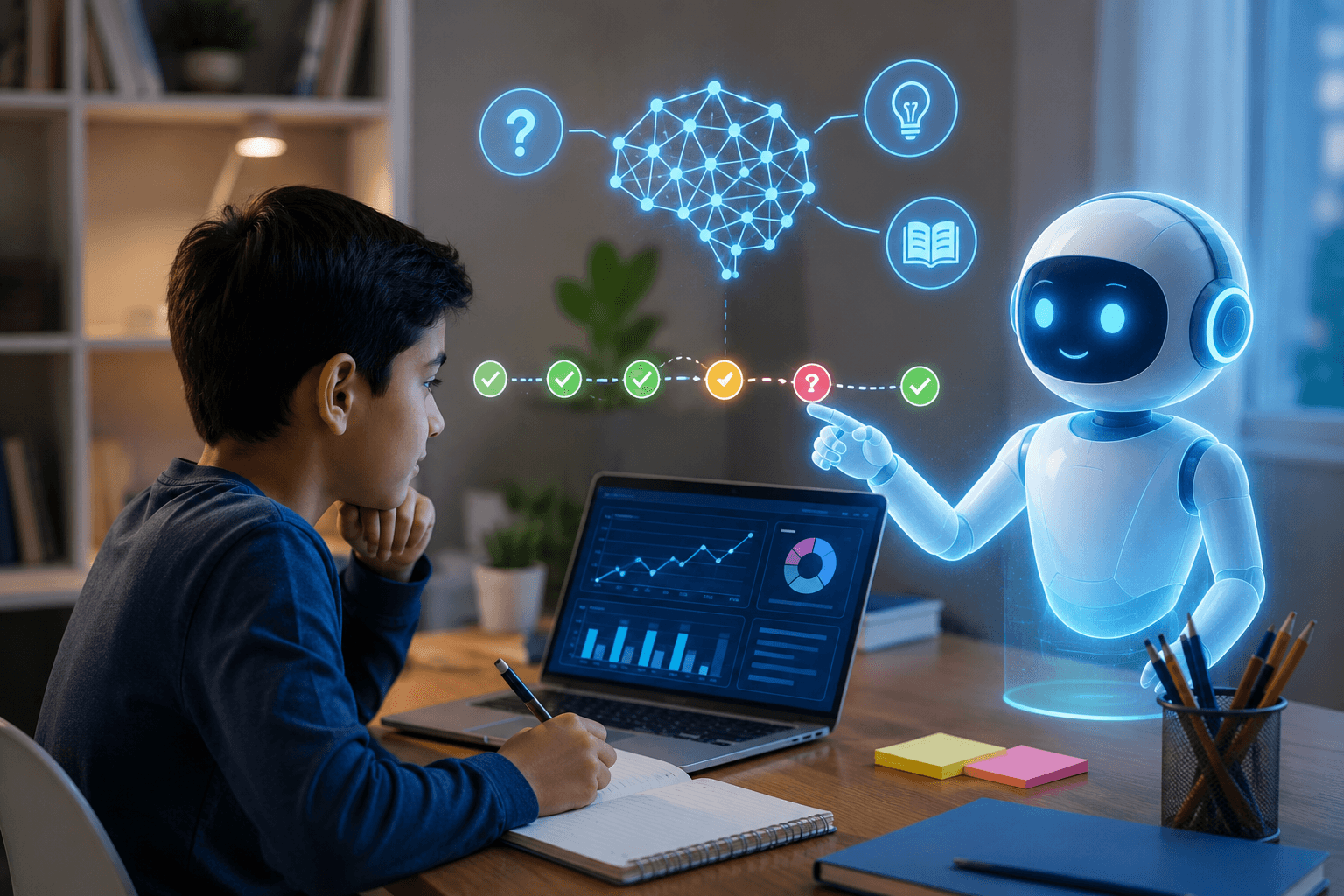
Modern AI tutoring systems can analyze a student's learning behavior, identify areas where they are struggling, and adapt learning activities to address those gaps.
But how exactly does this work?
What Is a Learning Gap?
A learning gap is a missing piece of knowledge or understanding that prevents a student from successfully learning a more advanced concept.
For example, a student may appear to struggle with algebra. However, the underlying problem may actually be difficulty with:
Basic arithmetic
Fractions
Negative numbers
Mathematical symbols
Understanding equations
Simply giving the student more advanced algebra exercises may not solve the problem.
An effective AI tutor attempts to identify the underlying concept that needs reinforcement.
How Does an AI Tutor Detect Learning Gaps?
1. Analyzing Student Responses
One of the simplest signals is how a student answers questions.
An AI tutoring system can analyze:
Correct and incorrect answers
Types of mistakes
Number of attempts
Time spent on questions
Patterns in repeated errors
Hints requested
Concepts requiring repeated explanations
For example, if a student repeatedly makes mistakes when adding fractions with different denominators, the system may identify fraction operations as an area requiring additional practice.
The goal is not simply to mark an answer as wrong.
The goal is to understand why it was wrong.
2. Identifying Patterns in Mistakes
A single incorrect answer does not necessarily indicate a learning gap.
However, repeated mistakes can reveal a pattern.
Imagine a student answers these questions:
2/3 + 1/4 → Incorrect 3/5 + 1/2 → Incorrect 1/6 + 2/3 → Incorrect
An AI tutor may recognize that the student understands addition but is struggling with finding common denominators.
Instead of continuing to provide random fraction questions, the system can return to the relevant concept and provide targeted instruction.
This is one of the important differences between adaptive tutoring and static digital content.
3. Mapping Knowledge Dependencies
Many subjects are built on prerequisite concepts.
For example:
Arithmetic → Fractions → Algebra → Equations → Advanced Mathematics
If a student has a weakness in fractions, that weakness can eventually affect algebra.
An advanced AI tutor can use a knowledge map or concept graph to understand relationships between concepts.
When the system detects difficulty with an advanced topic, it can look for weaknesses in prerequisite concepts.
This allows the learning experience to move backward when necessary rather than continuously pushing the student forward.
4. Adjusting Difficulty in Real Time
Once a potential learning gap has been identified, an AI tutor can adjust the difficulty of the next activity.
For example:
Student struggles → simpler explanation → guided example → practice → assessment → increased difficulty
If the student demonstrates mastery, the system can move forward.
If the student continues struggling, it can provide additional explanations, examples, or practice.
This creates a dynamic learning path rather than a fixed sequence of lessons.
5. Using Different Explanations
Sometimes the problem isn't a lack of knowledge—it is the way the concept is being explained.
A student may not understand a textbook-style explanation but may understand the same concept through a real-world example.
An AI tutor can potentially present information in different ways, such as:
Step-by-step explanations
Simple language
Examples
Analogies
Visual descriptions
Practice problems
Socratic questioning
Real-world scenarios
For example, instead of repeatedly explaining percentages using formulas, an AI tutor could explain percentages through shopping discounts, sports statistics, or everyday situations.
How AI Tutors Close Learning Gaps
Detection is only the first step.
The real value comes from using that information to create a targeted learning intervention.
Step 1: Identify the Weak Concept
The system analyzes performance and identifies a possible area of difficulty.
Step 2: Find the Prerequisite
The AI determines whether the student may be missing an earlier concept required to understand the current topic.
Step 3: Provide a Personalized Explanation
The tutor explains the concept using an approach appropriate to the student's current understanding.
Step 4: Give Targeted Practice
Instead of assigning dozens of unrelated questions, the student receives practice focused on the specific weakness.
Step 5: Reassess Understanding
The AI checks whether performance improves.
Step 6: Move Forward or Reinforce
If the student demonstrates understanding, the system can continue to the next concept. If not, it can provide another explanation or learning strategy.
AI Tutors Can Go Beyond Correct and Incorrect
One of the more interesting possibilities is analyzing how students learn rather than only whether they get answers right.
For example, an AI system could potentially observe patterns such as:
Frequently requesting hints
Changing answers repeatedly
Taking significantly longer on certain concepts
Making the same type of mistake
Completing some activities quickly but struggling with others
Demonstrating mastery in practice but struggling during assessments
These signals can provide a richer picture of learning.
However, such data should be interpreted carefully. A slow response does not automatically mean a student doesn't understand something. The system should treat these signals as evidence to investigate rather than definitive judgments.
AI Tutors and Personalized Learning Paths
Traditional educational content often follows a predefined sequence:
Lesson 1 → Lesson 2 → Lesson 3 → Lesson 4
An adaptive AI tutor can potentially create a more flexible pathway:
Student A: Lesson 1 → Lesson 2 → Lesson 3 → Lesson 4
Student B: Lesson 1 → Review → Practice → Lesson 2 → Lesson 3
Student C: Lesson 1 → Assessment → Advanced Lesson 2 → Lesson 3
The destination may be the same, but the route can differ.
This is particularly valuable in homeschooling, where learning can be organized around the individual student's pace.
The Role of AI in Homeschooling
For homeschooling families, identifying learning gaps can be challenging because parents may not always know which prerequisite concept is causing a problem.
An AI tutor can provide an additional layer of learning support by helping parents understand:
What the student is learning
Where the student is struggling
Which concepts may need reinforcement
What practice could be useful
When the student appears ready to move forward
This doesn't mean parents become less important.
Instead, AI can help parents make more informed educational decisions.
What About AI Tutor Accuracy?
AI-powered education also comes with important limitations.
An AI tutor can misunderstand a student's response, provide an incorrect explanation, or incorrectly infer the reason behind a mistake.
This is particularly important when AI is used with children.
A responsible AI tutoring system should therefore include safeguards such as:
Reliable educational content
Appropriate age-level explanations
Structured assessments
Human oversight
Clear uncertainty handling
Parent or educator visibility
Privacy protections
Regular evaluation of AI-generated content
AI should be treated as a learning support system, not an unquestionable authority.
The Future of AI-Powered Learning
The next generation of AI tutors could become much more sophisticated.
Instead of simply answering questions, future systems may combine:
Student profile + learning history + assessments + knowledge graph + AI reasoning + adaptive curriculum
This could allow AI tutors to continuously adjust a student's learning pathway.
Imagine a system that understands that a student has struggled with fractions for several weeks, recognizes the prerequisite concepts involved, generates a customized learning sequence, evaluates progress, and reports the results to the parent.
That moves AI tutoring beyond a simple chatbot.
It becomes a personalized learning system.
Final Thoughts
Learning gaps are not always obvious.
A student who struggles with advanced mathematics may not need more advanced mathematics. They may need help with a fundamental concept that was never fully understood.
AI tutors can help identify these hidden gaps by analyzing patterns in student responses, recognizing prerequisite relationships, adapting difficulty, and providing targeted practice.
The most powerful approach, however, is not AI instead of teachers or parents.
It is:
AI + personalized learning + human guidance.
When used responsibly, AI tutoring has the potential to make education more adaptive, more personalized, and more responsive to the unique learning journey of every student.